

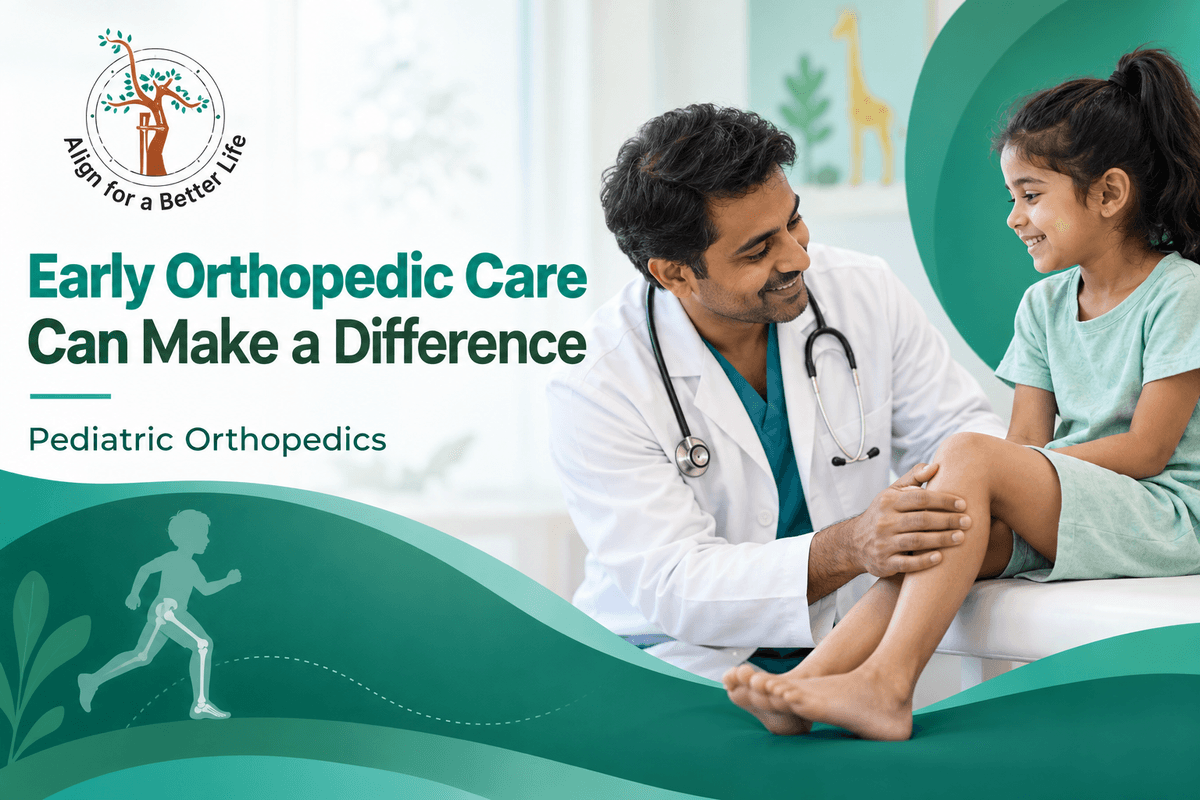
Why Early Orthopedic Care Can Make a Difference for Your Child
The Worry Every Kukatpally Parent Knows Too Well
Your child has been limping for two weeks. You assumed it was just a sprain from cricket practice. But now he avoids stairs, and his teacher says he sits out during PE class. You search online and the results terrify you — bone infections, growth plate damage, scoliosis. You wonder: Is this serious? Should I have acted sooner?
You are not alone. Across Kukatpally and neighbouring colonies like KPHB, Hydernagar, and Balanagar, parents face this dilemma every day. A child's bone, joint, or gait concern often gets dismissed as "growing pains" — until it doesn't go away. Common warning signals in children include persistent limping, visible swelling around joints, difficulty moving a limb, and unexplained stiffness — and because children's bones are still growing, issues that might seem minor can develop into more serious problems if left untreated.
The most important thing you can do for your child's musculoskeletal health is simple: act early.
What Happens When You Wait — And What Changes When You Don't
Congenital disorders such as clubfoot, developmental dysplasia of the hip (DDH), and developmental problems such as scoliosis can cause a lifetime of musculoskeletal disability unless they are treated early. This is not an exaggeration — it is the consistent message from medical research published over the last decade.
Studies have found a 60% drop in the rate of surgical interventions when early screening is used in some conditions. The overall impact of musculoskeletal disease in children is high, and it is important to diagnose and intervene as early as possible, because otherwise it may lead to progressive deformity.
Orthopedic and trauma conditions in children can have a significant impact on lifestyle and mobility due to the rapidly growing skeletal structure of the patient. Pediatric orthopedic disorders are treated and progress differently than those of adults and require special attention.
The good news is that children's growing bones are also their greatest asset. When treated during the right developmental window, many conditions respond remarkably well to non-surgical methods — bracing, casting, physiotherapy, or minor interventional procedures. Advances in early detection, imaging, and treatment have dramatically improved outcomes for children with conditions like scoliosis. The vast majority of children diagnosed today can be successfully treated without surgery when their condition is identified early.
The window for this kind of intervention is time-sensitive. Significant effectiveness of early rehabilitation has been observed in the high-risk group of children aged 6–9 years. Early diagnosis is critical for the success of conservative treatment; however, approximately 70% of children with scoliosis are still diagnosed too late.
Every month matters. Every growth cycle is an opportunity — or a missed one.
How Dr. Venkatram's Pediatric Orthopedic Practice in Kukatpally Helps
Dr. Venkatram's pediatric orthopedic clinic in Kukatpally is built around one core belief: children deserve a specialist who understands growing bones, not just bones. Children's bones contain growth plates — cartilage-rich zones where bone lengthening occurs — and these are uniquely vulnerable to injury, infection, and disease. Damage to growth plates can affect how a limb develops for years. This is why musculoskeletal concerns in children deserve evaluation from a specialist trained in pediatric development, rather than general orthopedics alone.
At the clinic, children from Kukatpally, KPHB, Hydernagar, Balanagar, Miyapur, and Moosapet receive thorough evaluations tailored to their age and stage of development. The approach is structured around three priorities:
1. Accurate Early Diagnosis Every consultation begins with a careful assessment of gait, posture, limb alignment, and growth plate health. Conditions like flat feet, in-toeing, bow legs, hip dysplasia, and spinal curvature are evaluated in context — because what is normal at age two may be pathological at age six.
2. Non-Surgical-First Treatment Philosophy Wherever clinically appropriate, Dr. Venkatram prioritises conservative management — corrective casting, bracing, guided physiotherapy, and close monitoring through growth spurts — before considering surgical options. Trends in management focus on minimally invasive, growth-preservation strategies. The Ponseti technique and Pavlik harnesses remain highly effective for clubfoot and DDH.
3. Family-Centred Care Parents are partners. Every diagnosis is explained in plain language, with a clear roadmap of what treatment involves, what to watch for at home, and when to return. Families from across Kukatpally appreciate the transparency and the accessibility of follow-up care.
The Evidence: Why Timing Is the Deciding Factor
The numbers behind early pediatric orthopedic intervention are compelling.
Clubfoot: When the Ponseti method is initiated early — ideally before a child begins to walk — and applied correctly, it results in full mobility in 95% of cases. The Ponseti treatment has a 95% success rate in correcting clubfoot, providing children with optimal mobility. Long-term outcomes include well-aligned feet, improved leg muscle function, and high activity levels — Ponseti-treated children typically walk, run, and play just like other kids.
Hip Dysplasia (DDH): In infants with reducible hips below 6 months of age, the Pavlik harness remains first-line treatment, achieving 85–95% success in recent cohorts. Delay beyond infancy frequently necessitates open surgery.
Scoliosis: Thanks to improved screening and earlier intervention, approximately 96% of children with adolescent idiopathic scoliosis can be managed without surgery — a remarkable shift from outcomes seen just decades ago. Starting treatment early, especially when the spine's curve is between 20–25 degrees, may lead to better outcomes.
India Context: In India, the prevalence of trauma in child patients ranges from 5.5 to 19.23%, with orthopedic injuries accounting for the largest proportion. The greatest risk occurs during the schooling years, because children develop a sense of independence that predisposes them to new risks. Congenital deformities such as clubfoot and developmental dysplasia of the hip are prevalent in India. Early access to a specialist in your own locality — such as right here in Kukatpally — can dramatically change the outcome for a child.
Pediatric orthopedic care goes beyond fixing bones — it's about ensuring long-term strength, health, and mobility. That is the commitment Dr. Venkatram brings to every child who walks through the clinic door.
Frequently Asked Questions
1. At what age should I take my child to a pediatric orthopedic specialist?
There is no minimum age — and no age too young. Newborns can be assessed for hip dysplasia and clubfoot in the first days of life, which is when treatment is most effective. Toddlers and school-age children should be evaluated if gait, posture, or limb alignment concerns arise. Developmental conditions like hip dysplasia or clubfoot require early intervention, as these conditions affect normal bone and joint development if left untreated. An orthopedic doctor for kids can identify these problems early and implement treatment plans that support normal development.
2. How is pediatric orthopedic care different from regular orthopedics?
Children's bodies are not just smaller versions of adults' bodies — they are still developing. Growth plates, the areas of new bone development, remain open until the end of puberty. A pediatric orthopedic specialist is trained to work within these developmental windows, choosing treatments and implants that preserve growth rather than interrupt it. Diagnoses, surgical techniques, and even casting methods differ significantly from adult orthopedics.
3. What are the warning signs that my child needs to see a pediatric orthopedic doctor in Kukatpally?
Warning signs include persistent pain or discomfort, difficulty walking or limping, reduced range of motion, swelling in joints or limbs, and visible deformities. Additionally, patterns such as uneven limb lengths or asymmetry, delayed or abnormal walking, bowed legs or in-toeing beyond toddler years, visible spine curvature, and hip or pelvic irregularities all warrant a specialist evaluation. For parents in Kukatpally, KPHB, and surrounding areas, the key rule is: if a symptom lasts more than a week without a clear cause, consult a specialist.
4. Is surgery always needed for conditions like bow legs, flat feet, or scoliosis?
No — and in most cases, it is not the first option. Some alignment variations are normal in early childhood — bow legs, knock knees, in-toeing — and many resolve on their own. Surgical involvement becomes important only when the deformity is severe or worsening, one side is significantly different from the other, gait is affected, or the deformity persists beyond expected age windows. For scoliosis specifically, bracing and physiotherapy are first-line treatments when the condition is caught early enough.
5. My child was recently diagnosed with clubfoot. What are the treatment options, and how soon should we start?
Start as soon as possible — ideally within the first two weeks of birth. When treatment is initiated during infancy using the Ponseti method, correction is usually achieved within six to eight weeks. Ideally, treatment should begin within a week after birth, when the tendons and ligaments are at their most elastic. The Ponseti method — a series of gentle manipulations and plaster casts — is the gold standard globally and in India. The initial efficacy rate of the Ponseti method reaches almost 100% when started early, and it is also effective in older children, preventing open joint surgery in almost every case. Families in Kukatpally and across KPHB can access this treatment close to home without travelling across the city.
Visit Us
Visit Dr Venkatram for trusted, compassionate care. We're here for you and your family.
Dr Venkatram
Kukatpally
Phone: 919177816855
Website: www.drvenkatramkidsortho.com/
Google Maps: https://www.google.com/maps/place/?q=place_id:ChIJTbPoGX6TyzsRpzqr-vFWscs
Email: venkat_thyalapalli@yahoo.com